

How to Choose the Best Office Furniture for Flexible Workspaces in 2026
Modern business environments require agility to survive and thrive. In 2026, the traditional fixed office layout has become a relic of the past, replaced by dynamic environments that adapt to team needs. Choosing the right office furniture for flexible workspaces is no longer just an aesthetic choice; it is a strategic business decision. Companies now face the challenge of balancing collaborative zones with private focus areas. This article provides a comprehensive guide to selecting furniture that supports movement, technology integration, and employee well-being. By the end of this guide, you will understand how to build a future-proof office that scales with your growth.
The Rise of Agile Work Culture in 2026
The shift toward agile work culture has fundamentally changed how we view office assets. Businesses now prioritize furniture that can be moved, stored, or reconfigured in minutes rather than hours. This flexibility allows companies to respond to changing project requirements and fluctuating staff numbers without a full renovation.
Successful flexible workspaces rely on the concept of activity-based working. This means providing different types of furniture for different tasks, such as quiet zones for focus and open lounges for brainstorming. Investing in versatile pieces ensures that every square meter of your office provides maximum value.
Maximizing Utility with Modular Desks
Modular desks are the backbone of any flexible workspace. These units often feature locking casters and folding mechanisms, allowing them to be rearranged for training sessions, team sprints, or individual focus work. In 2026, the best modular systems include integrated cable management to keep workspaces tidy during transitions.
When selecting modular desks, consider the ease of assembly and the durability of the moving parts. High-quality hinges and robust wheel systems are essential for furniture that will be moved frequently. Look for designs that allow desks to be linked together to create larger conference surfaces when needed.
| Feature | Benefit | Flexibility Level |
|---|---|---|
| Locking Casters | Easy mobility and stability | High |
| Tool-less Assembly | Rapid reconfiguration | Extreme |
| Integrated Power | Seamless tech connectivity | Medium |
| Nesting Frames | Space-saving storage | High |
Key Features of Flexible Desking Systems
A high-performance desking system should offer height adjustability to support ergonomic health. Electric sit-stand mechanisms are now standard in 2026, helping employees stay active throughout the workday. Additionally, lightweight materials make it easier for a single person to reconfigure a room without professional assistance.
Acoustic Privacy in Open-Plan Layouts
One of the biggest challenges of flexible workspaces is noise control. Without permanent walls, sound can travel easily and disrupt concentration. Acoustic pods and mobile privacy screens have become essential office furniture for flexible workspaces to mitigate this issue.
Modern acoustic pods offer a room-within-a-room solution for private calls and video conferences. These units are often modular themselves, meaning they can be disassembled and moved if the office layout changes. For smaller budgets, high-density foam screens provide an effective way to block visual distractions and dampen ambient noise.
Collaborative Seating for Modern Teams
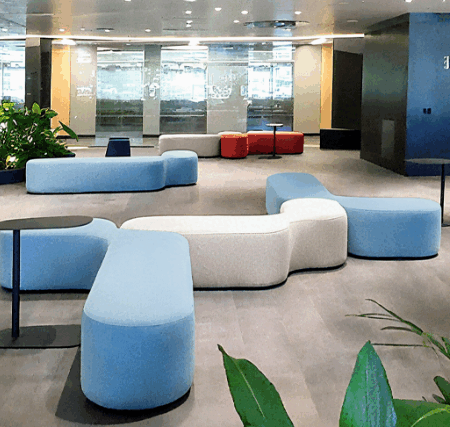
Collaborative seating should encourage interaction while remaining comfortable for long periods. Modular sofas and tiered seating units allow teams to create custom configurations for informal meetings. These pieces often feature built-in charging ports to ensure that laptops and mobile devices stay powered.
In 2026, the trend is toward lightweight, nesting chairs that can be stacked and moved to the perimeter of a room. This allows a collaborative zone to transform into an open event space in minutes. Choosing fabrics that are easy to clean and durable is vital for these high-traffic areas.
Technology Integration and Smart Furniture
The best office furniture for flexible workspaces in 2026 is inherently tech-enabled. This goes beyond simple power outlets to include wireless charging surfaces and IoT sensors. These sensors can track furniture usage patterns, helping facility managers optimize the office layout based on real-time data.
Smart furniture also includes height-adjustable desks that remember user preferences. This is particularly useful in hot-desking environments where different employees use the same workstation throughout the week. Seamless technology integration reduces the friction often associated with moving between different work zones.
Sustainability in 2026 Office Procurement
Sustainability is a primary concern for modern procurement managers. Flexible furniture should be built to last, reducing the need for frequent replacements. Look for manufacturers that use recycled metals, sustainable wood sources, and low-VOC finishes to protect indoor air quality.
In 2026, many companies are looking for a circular economy approach to furniture. This includes choosing pieces that are easy to repair or upgrade rather than discard. Modular designs naturally support this by allowing individual components, like desk tops or chair cushions, to be replaced without replacing the entire unit.
Future-Proofing Your Workspace Strategy
Planning a flexible office requires a long-term vision. Start by analyzing your current team workflows and identifying where the most movement occurs. Purchase furniture that can grow with you, such as benching systems that allow for easy expansion through add-on kits.
Work with a consultant or a specialized furniture provider to map out different layout scenarios. This ensures that the furniture you buy today will still be relevant as your business evolves. Remember that the most flexible workspace is one that empowers employees to control their own environment.
Investing in the Future of Work
The transition to flexible workspaces is an investment in your company’s most valuable asset: its people. By providing versatile, high-quality furniture, you create an environment that fosters creativity and productivity. In 2026, the ability to adapt is the ultimate competitive advantage.
Whether you are a startup or an established enterprise, the right furniture strategy makes a significant difference. Focus on modularity, technology integration, and sustainability to ensure your office remains functional and inspiring for years to come.
Need a tailored shipping solution?
Ready to transform your office with the best office furniture for flexible workspaces? Contact our procurement experts today to discuss your 2026 project requirements and request a custom quote.